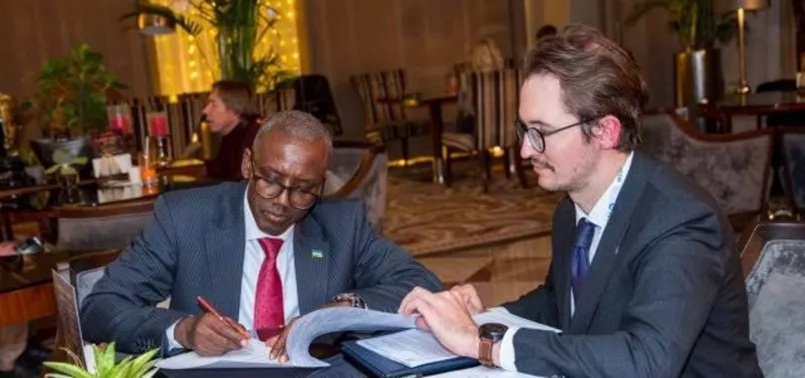
The memorandum was signed on October 28, 2026, on the sidelines of the third Russia–Africa Summit in Moscow. Rwanda’s Ambassador to Russia, Maj. Gen. Joseph Nzabamwita, signed on behalf of Rwanda, while Nikolay Spassky, Rosatom’s Deputy Director General for International Activities, represented the Russian corporation.
According to Rosatom’s announcement, published on October 29, the document provides for an assessment of Rwanda’s nuclear infrastructure needs, taking into account the approaches and recommendations of the International Atomic Energy Agency (IAEA). It is intended to identify the next steps required to advance the country’s programme.
The broader cooperation centres on two major projects: a small modular nuclear power plant and a Centre for Nuclear Science and Technology. Announcing the development on October 31, Ambassador Nzabamwita said construction would begin soon and create employment opportunities for young Rwandans.
However, the latest memorandum concerns infrastructure assessment and development. A final reactor construction contract and a detailed implementation timetable have not been publicly announced.
Electricity and wider development ambitions
Rwanda is pursuing nuclear energy to diversify its electricity supply and meet growing demand from households, businesses and industry. The country has announced an ambition to generate an initial 110 megawatts of nuclear electricity between 2030 and 2033.
That figure represents a national programme objective; it should not be read as a confirmed capacity or delivery commitment under the newly signed memorandum.
Beyond electricity generation, the planned cooperation extends to healthcare, agriculture, mining and mineral processing. The proposed Centre for Nuclear Science and Technology is expected to support applications such as cancer treatment, preservation of agricultural produce and geological surveys.
These applications would broaden the programme’s contribution to development, linking energy policy with medical services, food preservation and scientific capacity.
Training Rwanda’s future specialists
Human capital development is another central component of the partnership. Rosatom reports that 102 Rwandan students are currently studying at Russian universities through its programmes.
The corporation says its cooperation with Rwanda combines preparation for nuclear facilities with the training of future professionals and the development of the national infrastructure needed to support peaceful nuclear activities.
The latest agreement builds on several years of cooperation. Rwanda and Russia signed an intergovernmental agreement on the peaceful use of nuclear energy in December 2018, followed in 2019 by an agreement concerning a Centre for Nuclear Science and Technology.
On July 29, 2026, RAEB and Rosatom held their first Joint Coordinating Committee meeting in Moscow and signed a roadmap on small modular reactors. Their discussions covered electricity generation, non-power applications, personnel training, national infrastructure and regulatory preparations.
For Rwanda, the October memorandum marks a further preparatory step towards its nuclear ambitions. Translating those ambitions into operating facilities will depend on the subsequent technical, regulatory, financing and construction arrangements.


 By RWANDAPODIUM